
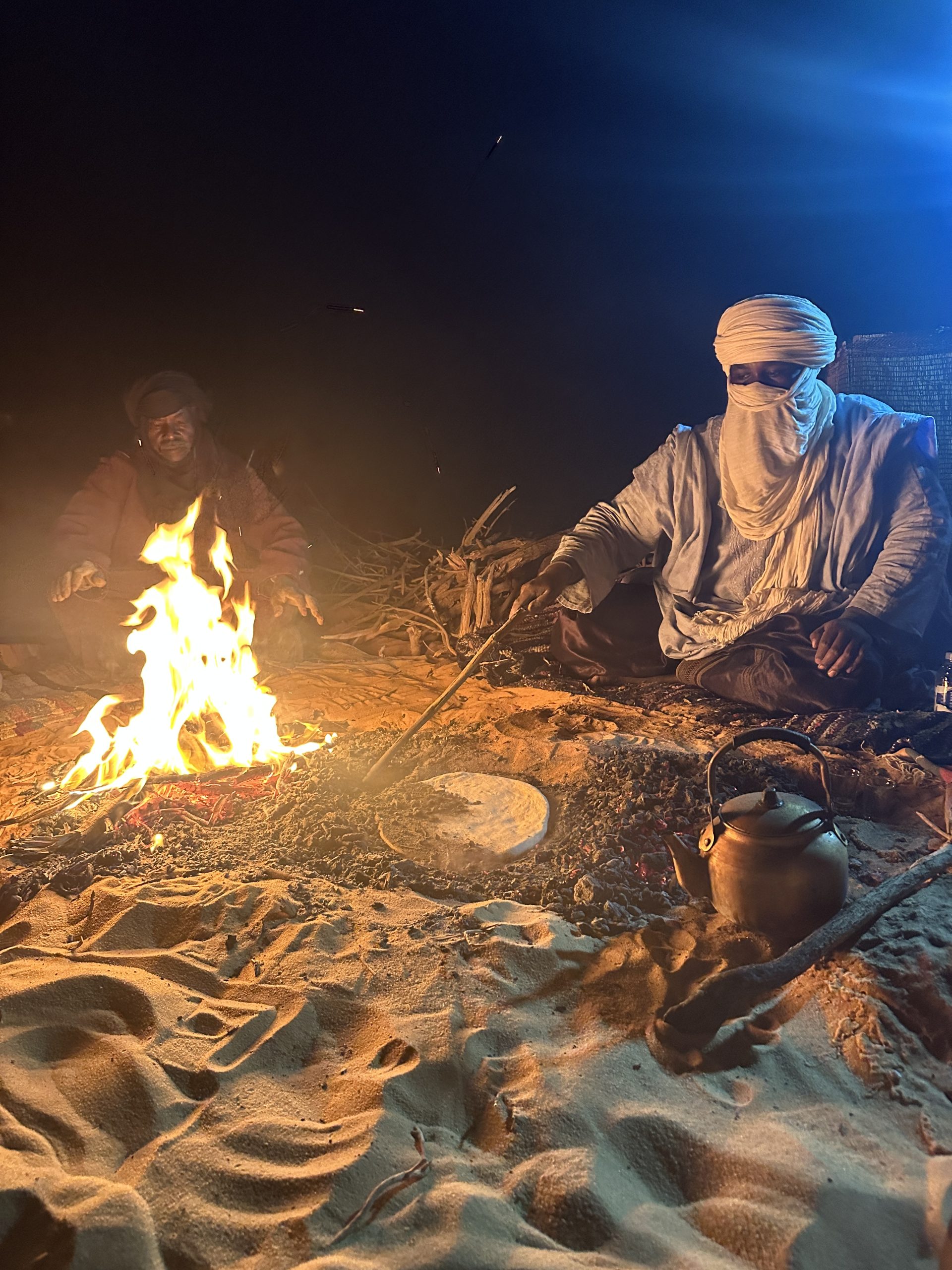
The Tuareg people of Libya are among the most enduring desert societies in North Africa. For centuries, they have lived, traveled, and thrived across the Sahara, shaping the cultural identity of southwestern Libya. From the Fezzan region to the oasis town of Ghat and the Acacus Mountains, Tuareg culture in Libya reflects deep knowledge of the desert, strong social traditions, and a history tied to trans Saharan trade.
Understanding the Tuareg Sahara lifestyle offers rare insight into how humans adapted to one of the most extreme environments on earth.
Who Are the Tuareg People of Libya
The Tuareg are an Amazigh people whose traditional homeland stretches across the central Sahara. In Libya, Tuareg communities are mainly found in Fezzan, particularly around Ghat, Ubari, and areas near Ghadames. They speak Tamasheq, a Berber language that has historically been written using the Tifinagh script.
Rather than identifying with modern national borders, Tuareg identity developed around clan affiliation, desert regions, and seasonal movement. This mobility shaped Tuareg history in Libya and connected them to trade networks across North and West Africa.
The Sahara as a Homeland for the Tuareg
For the Tuareg nomads of Libya, the Sahara is not an empty wilderness but a living landscape. Knowledge of grazing lands, water sources, winds, and stars has guided Tuareg movement for generations. Seasonal travel with camels, goats, and sheep allowed families to survive in extreme heat and scarce rainfall.
In Fezzan, many Tuareg combined pastoral life with oasis agriculture, cultivating dates and small crops where water permitted. This balance between movement and settlement defined Tuareg desert culture in Libya.
Tuareg History and Desert Empires
Tuareg history in Libya is closely linked to their control of desert space rather than walled cities. From the early Islamic period onward, Tuareg confederations ruled vast Saharan regions by managing trade routes, wells, and caravan movement.
Their influence functioned as a desert empire built on knowledge and mobility. Protection of caravans, control of water points, and safe passage across the Sahara gave the Tuareg authority across Fezzan and beyond.
Trans Saharan Trade and Tuareg Power
The Sahara once connected civilizations. Tuareg tribes in Libya played a central role in trans Saharan trade routes linking Tripoli and Ghadames to the Sahel. Caravans transported salt, gold, dates, textiles, and livestock across the desert.
Tuareg guides and protectors made these journeys possible. Their role in trade allowed Fezzan to become a major crossroads and reinforced Tuareg economic importance throughout the Sahara.
Ghat and the Kel Ajjer Tuareg
Ghat stands as one of the most important Tuareg centers in Libya. For centuries, it served as the heart of the Kel Ajjer Tuareg confederation. The town connected caravan routes between Libya, Algeria, and Niger.
Leadership was held by respected figures known as amenokal, whose authority came from lineage, wisdom, and the ability to maintain balance within the community. Ghat functioned as a cultural, commercial, and social center of Tuareg life in the Libyan Sahara.
Tuareg Social Structure and Family Life
Tuareg society traditionally revolved around extended families and clans. Social organization emphasized cooperation, hospitality, and mutual responsibility. While historical social divisions existed, daily life depended on shared survival in the desert.
Tuareg women held strong social roles. Property such as tents often belonged to women, and family lineage commonly followed the female line. Women also preserved poetry, songs, and oral history, making them central to cultural continuity.
Tuareg Clothing, Crafts, and Daily Life
Tuareg clothing is both symbolic and practical. The indigo dyed veil worn by many Tuareg men protects against sun and sand and serves as a marker of identity. Over time, the dye often stained the skin, leading to the well known description of the Tuareg as the blue people of the desert.
Traditional crafts include silver jewelry, leatherwork, swords, and camel equipment. These items remain important expressions of Tuareg culture in Libya and are often passed down through generations.
Daily life values simplicity, resilience, and generosity. Hospitality toward travelers remains a defining feature of Tuareg society.
Tuareg Language, Poetry, and Music
Tamasheq language lies at the heart of Tuareg identity. Poetry has long been used to express love, honor, exile, and history. Oral storytelling serves as a living archive, preserving collective memory.
In recent decades, Tuareg music has gained international recognition. Modern desert blues blends traditional themes with contemporary instruments, sharing Tuareg stories with global audiences while remaining deeply rooted in Saharan identity.
Traditional and Modern Tuareg Economy
Historically, the Tuareg economy in Libya depended on pastoralism, caravan services, and trade. Camels were essential for transport and survival, while herding provided food and status.
Today, many Tuareg combine traditional livelihoods with modern opportunities. Town based work, crafts, small trade, and cultural tourism now support families. In places like Ghat and the Acacus Mountains, responsible tourism helps preserve Tuareg heritage while supporting local communities.
Tuareg Environmental Knowledge in the Sahara
Tuareg survival relied on sustainable desert practices. Seasonal movement prevented overgrazing, while knowledge of underground water systems and oasis management ensured long term survival.
This environmental wisdom remains highly relevant. As climate challenges increase, Tuareg knowledge of desert ecosystems continues to offer valuable lessons in sustainability and adaptation.
Tuareg Culture in Libya Today
Tuareg culture in Libya today reflects continuity and change. Younger generations pursue education while maintaining strong cultural ties. Festivals, music, crafts, and storytelling continue to transmit Tuareg identity.
Despite modern pressures, Tuareg communities remain deeply connected to the Sahara. Their history is carried through routes, songs, and shared memory rather than monuments.
Why Tuareg Culture Matters to Libya
The Tuareg people of Libya are guardians of Saharan knowledge and history. Their control of trade routes, environmental adaptation, and cultural expression shaped Fezzan for centuries.
For travelers seeking deeper cultural understanding, learning about the Tuareg offers insight into Libya beyond its coastal cities. At IntoLibya, we believe that respectful travel begins with understanding. Exploring Tuareg history and culture reveals the human story of the Sahara and the people who mastered it.
Visit the Tourag with @intoLibya